On 19 March 2026, the Global Buildings Performance Network (GBPN) hosted an international webinar titled “Accelerating Heat Pump Deployment: Policy, Markets, and Lessons from Emerging Economies.” The event brought together global experts to share insights on scaling up heat pump adoption as a key pathway to decarbonizing heating and cooling systems.
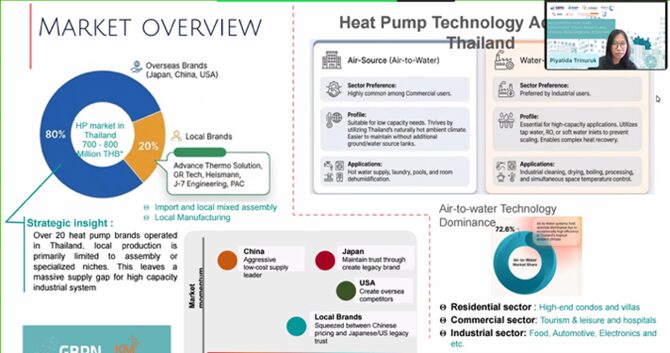
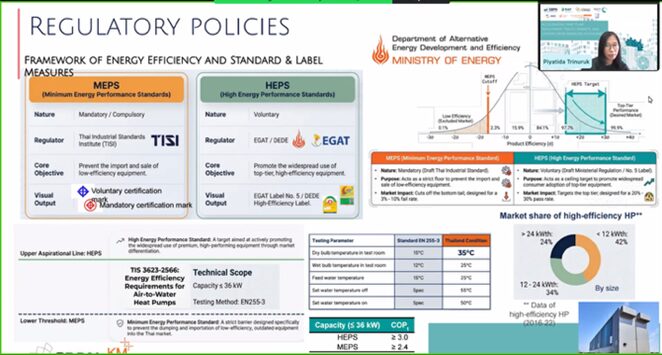
Assist. Prof. Dr. Piyatida Trinuruk Kaewchinda of Joint Graduate School of Energy and Environment, King Mongkut’s University of Technology Thonburi (JGSEE-KMUTT) represented Thailand in the country case study session. She presented national perspectives on market conditions, policy frameworks, financing mechanisms, and the opportunities and challenges associated with expanding heat pump deployment.
A heat pump is a device that uses electricity to move heat from one place to another, rather than generating heat directly. For example, it can take heat from the air outside (even when it feels cold) and transfer it indoors to warm a building – or reverse the process to cool it – making it a very energy-efficient way to control temperature.
The webinar opened with a global overview of heating-related emissions and the role of heat pumps in building decarbonization, delivered by Mr. Duncan Gibb of the Regulatory Assistance Project (RAP). Dr. Peter Graham, Executive Director of GBPN, introduced the organization’s work and underscored the importance of transforming heating and cooling systems to meet climate targets.
The country case study session also featured experts from New Zealand, Australia, Indonesia, and India, offering comparative insights into heat pump development and deployment across diverse emerging economies.
In her closing remarks, Ms. Mugure Njendu of GBPN emphasized the critical role of heat pumps in the global transition to low-carbon buildings and encouraged participants to explore the Global Heat Pump Toolkit developed by GBPN and its partners, including RAP, CLASP, and Agora Energiewende, which offers tools and guidance on designing effective policy packages to accelerate heat pump deployment.