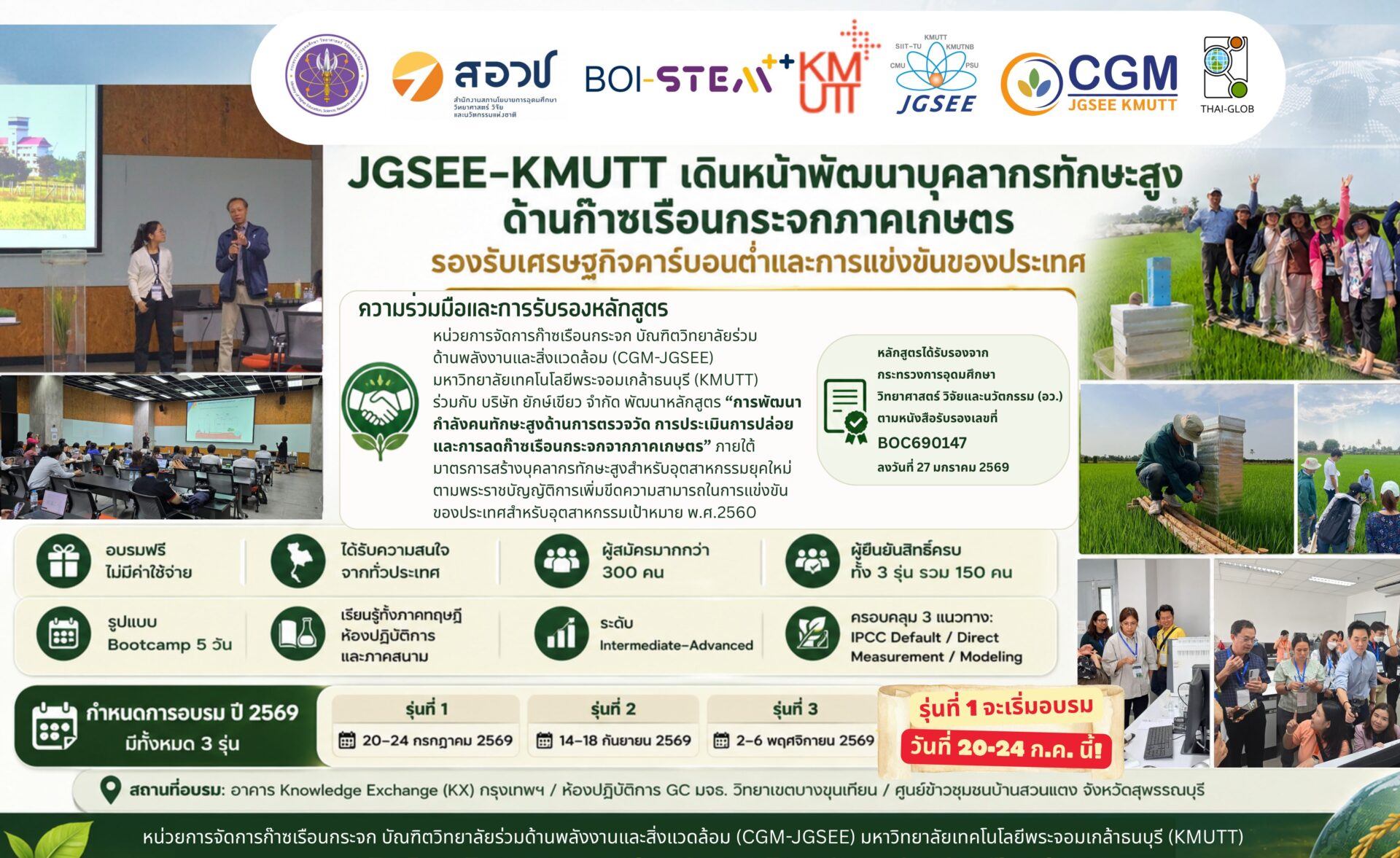

The Center of Greenhouse Gas Management (CGM) of the Joint Graduate School of Energy and Environment (JGSEE) at King Mongkut’s University of Technology Thonburi (KMUTT), in collaboration with Yak Green Company Limited, is launching the “High-Skilled Workforce Development Program in Agricultural Greenhouse Gas (GHG) Measurement, Assessment, and Mitigation” to strengthen Thailand’s technical capacity for climate action in the agricultural sector.
The training program is implemented under the High-Skilled Workforce Development Measure for New S-Curve Industries, established under the National Competitiveness Enhancement for Targeted Industries Act, B.E. 2560 (2017). Accredited by the Ministry of Higher Education, Science, Research and Innovation (MHESI), the program contributes to Thailand’s transition toward a low-carbon economy while strengthening the competitiveness of its agricultural sector.
The program is expected to train 150 participants in 2026 through three training cohorts, with the first cohort scheduled for 20–24 July 2026. Designed as an intermediate-to-advanced hands-on training program, the five-day bootcamp combines classroom instruction, laboratory practice at KMUTT, and field-based learning at the Ban Suan Taeng Community Rice Center in Suphan Buri Province. Participants will gain the knowledge and technical skills required to measure, assess, and mitigate GHG emissions from the agricultural sector in accordance with scientific principles and international standards.
The curriculum covers the three principal approaches to greenhouse gas assessment: IPCC default methodologies, direct measurement, and modeling. Participants will learn the strengths and limitations of each approach and how to select the most appropriate methodology for different agricultural production systems.
Beyond greenhouse gas assessment, the program emphasizes the design of emission mitigation measures that balance production efficiency, food security, and sustainability. Participants will also learn how greenhouse gas data can support both technical and policy decision-making, including applications in carbon credit schemes, greenhouse gas inventory development, and compliance with the environmental requirements of global markets.
By strengthening national expertise in agricultural greenhouse gas management, the program will help accelerate emissions reduction in the agricultural sector, support Thailand’s transition to a low-carbon economy, and enhance the global competitiveness of the country’s agricultural production.